

🤔 👀 POST 2: $5M to $25M An Eye-Opening Look at Infrastructure Cost Escalation 👀 🤔: 8 December 2024
🤔 👀 POST 2: $5M to $25M An Eye-Opening Look at Infrastructure Cost Escalation 👀 🤔

A couple of days ago I put up a post touching on NZ being fairly poor performing (‘bang-for-buck’) for infrastructure delivery.
My objective is to raise curiosity and encourage others (better equipped than me) in NZ to look at the way our growth projects are worked up into development contributions payable by today’s new home buyers.
Australia is a bit better but certainly not best in class. Chile, Spain, UK, Singapore do far better (search for the Infrastructure Commission report called Investment Gap or Efficiency Gap).
My opinion is that developers need to look at the details around our spending. So I am posting on LinkedIn about it in the ‘hope’ that others might look too .
I’ve been looking (as best as I can) at a local intersection upgrade project (AT’s RWW_26a for Brigham Creek Road, 2-lane urban upgrade) and the numbers reveal how costs multiply through percentage-based additions and delays.
Today’s new home buyers will be paying for this project and they won’t get any benefit for many years.
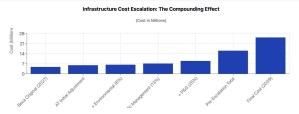
$4.8 million up to $25 million.
Starting with the Beca base estimate of $4.8M:
AT converts this to $6.0M using unit rate adjustments (I think this is adjusting it from the estimate a year ago to now or 2027… I’m not sure).
Then the compounding begins starting with the addition of AT’s costs.
Add 6% for environmental: $6.0M → $6.36M
Add 13% for traffic management: $6.36M → $7.19M
Add 25% for preliminaries & general: $7.19M → $8.97M
From there MORE is added:
Add the ‘Client’ costs then the contingencies to aspects of those and we get to:
Further additions bring it to $16.1M before escalation
A factor of 1.52 is applied for the time-based escalation (because AT have pushed it from 2027 to 2039).
The final cost to $25.3M
That’s over 5x the original estimate! $5M to $25M.
Two key drivers that I have observed in my ‘fumbling’:
Most ‘number treatments’, build on previous increases rather than the original amount.
The takeaway? When we delay infrastructure projects, we don’t just add costs – we multiply them. What could be built for $4.8M in 2024 will cost taxpayers and ratepayers $25.3M in 2039. Actually, they will be paying for it now at the escalated value if I am understanding correctly (put me right if wrong).
This is paid for by TODAY’s payers and they won’t see a single benefit until 2039!
Is this the most efficient way to deliver infrastructure?
Note: this whole project is not assigned to the full Inner West DC and there are +/- interest factors applied in other worksheets that is above my ‘pay-grade’.
Why can’t we use the infrastructure funds and have a private company execute the work as it just adds extra cost layers on including contingencies.
Could Councils facilitate this?
