

Kaitiakitanga belongs to our infrastructure too
Kaitiakitanga belongs to more than forests and speeches. It belongs to our infrastructure too: our duty to hold it in trust for those who follow.
In my mind, the capital providers should get a return on their money, but what is left after that should be going back into the network, not selfishly extracted to benefit us right now.
You build a stronger electricity network by maintaining and enhancing it. Not by looking at it less often.
Vector has found a new kind of efficiency. Fewer inspections, fewer site visits, it seems to be a notable cut to routine maintenance.
From 2021 to 2024 every pole mounted transformer was inspected once a year, and poles and their attachments every two years. The 2026 plan stretches that time out a bit, and saves $10 million. This was recorded as: “changes to maintenance standards”.
New technology helps. GridAware uses drones, thermal imaging and AI over the images, and I like it. Hopefully it isn’t a reason to look less. Hopefully it means look better.
Vector has told the Commerce Commission their new approach has “reduced the need for site visits” and that “fewer and more specialised inspectors are now necessary”.
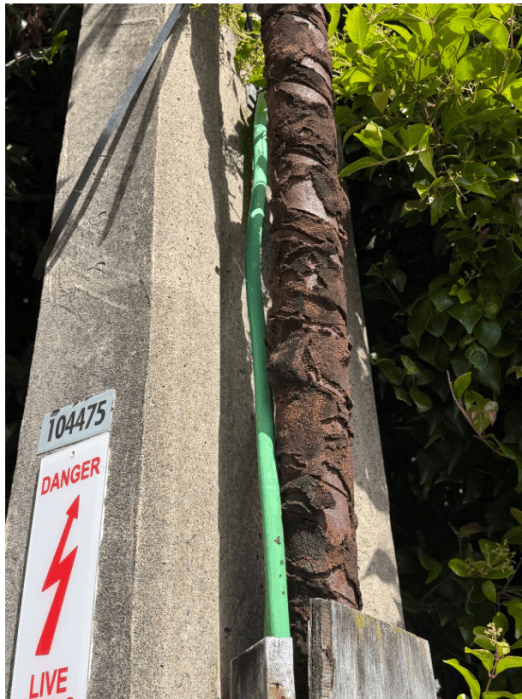
A drone is good at some faults. Will it see a crossarm sitting inside a tree canopy? Will it see a hopelessly aged pole run cable?
I walked one block with a phone. That was enough. Do we want Wellington’s water debacle to hit our electricity distribution networks?
Choices now matter very, very much in fifty years.
Vector has been replacing the old cast metal cable ends known as potheads since 2004. Their 2021 plan said it had 2 or 3 years to run. The same was repeated in 2024. The 2026 plan says most are complete. What does that mean, particularly when the failure risk is “the potential for explosive shattering”? I would like to know what was competing for the money. Was it dividends, or capital being extracted as some might say.
I am hot under my collar because Entrust holds 75.1 per cent of Vector and their priority is to pay out cash dividends. Last year Entrust paid $364 to each of more than 372,000 account holders, roughly $135 million in cash. Their annual commitment to undergrounding and other improvements is a mere $12.5 million. Would a better and future proofed network bring a better return?
Do we want Wellington’s water bills to be our power bills in twenty years? The Piper eventually gets paid.
And who pays? Our children and their children.
The MBIE consultation closes 22 September. SANZ will be making a submission.
Look up and beside. If a pole near you needs attention, report it to Vector. I reported one this morning.
