

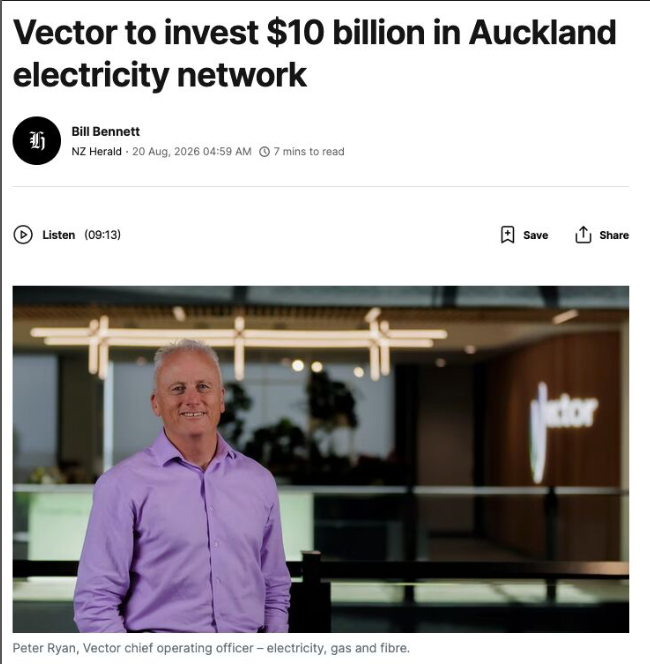
Vector says a typical new connection averages $8,000. My reverse maths says $14,028.
Vector told the Herald a typical new connection averages $8,000. My reverse mathematics on Vector’s 2026 annual report comes to $14,028.
$182.6 million collected from new connections. Divided by 13,017 of them.
Stay with me while I test that $8,000 against the total from public reports.
Vector are likely to say the $182.6 million includes relocations. That is fair. So I will take them out.
Vector’s previous four years of Commerce Commission disclosures show relocations at 8 to 10 per cent of the total. Strip 10 per cent off and the average new connection over the past year is about $12,600.
For $8,000 to be the average, relocations would have to be 43 per cent of what Vector collected. Their own disclosures say 8 to 10 per cent.
There is a bigger problem, and it is the word “typical”.
There is no typical connection. A greenfield subdivision? A data centre? An infill site sitting next to old lines? These are very different jobs.
The costs do not gather in a neat bell curve with $8,000 in the middle. More likely it is multi-modal, which just means more than one peak. So how big is the $8,000 peak? What about the location patterns? I cannot work that out from the disclosures.
$8,000 is the easy group. I know, because I have had one. My connection in Manurewa needed almost no real work and came in around that figure. I thought it was steep at the time, for affordable housing.
An average is every job. Including the ones that do not make for an easy read. So which connections is the $8,000 an average of? What does the hard group cost?
At the foot of the article: “Vector is a sponsor of the Herald’s Infrastructure report.” A sponsored article is still an article. It does not address any of this.
I suspect the writer has wandered into a highly contentious topic that cannot be a surface wipe. It affects all consumers, and first home buyers in particular.
