

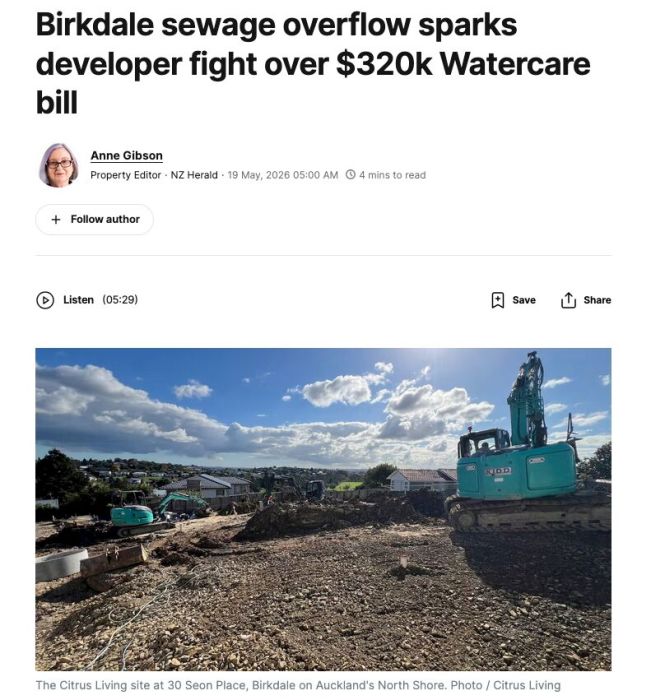
Raw Sewage on Someone’s Lawn and a $320,000 Bill for the Developer Next Door
Raw sewage on someone’s lawn and a $320,000 bill for the developer next door. Welcome to building in Auckland.
Watercare is in the NZ Herald today over a $320,000 bill to a developer in Birkdale. The developer is being asked to pay $220,000 in infrastructure growth charges plus $100,000 to upgrade a public sewer main that is already failing. Raw sewage is running across a neighbouring property every time it rains heavily. And Watercare cannot say when that will be fixed.
Their chief strategy and planning officer seems to have told the paper that the infrastructure growth charge “varies throughout the city.”
On 7 April 2026, Watercare wrote to Subdivision Advocacy NZ confirming that it does not operate a location-based IGC policy. The charge is calculated per development unit equivalent (DUE), which is a standard volume of assumed water use. One DUE is 220 kilolitres per year. The rate per DUE is the same across Auckland. It does not change by suburb. Nor does it charge by size. SANZ data shows that a small home, even a modern three bedroom apartment, uses less than half that amount. Yet they pay the full amount. Subsidising the big.
This is part of a pattern. SANZ has been corresponding with Watercare since late 2025 on several issues, and the answers we get in writing do not always match what is understood in other places. Even Christopher Bishop was not aware that the charge was a flat rate where small pays the same as big. So what of the sound-bite “growth pays for growth”? Yeah, nah. Small pays for everyone else, including established homes.
It is interesting how they classify pipes. Watercare told us that whether a pipe is “local” or “transmission” infrastructure depends on its function and can change. The same pipe could be local in one location and transmission in another. That matters because it determines who pays for upgrades. If Watercare calls a pipe “local,” the developer pays. If it is “transmission,” Watercare is supposed to fund it from growth charges. In Birkdale, the developer is being told to pay $100,000 to upgrade a sewer main that was already overflowing. That is a public infrastructure failure being passed on to a private developer. Two other developers nearby have stalled their projects over the same pipe problem.
New homes are paying growth charges that are supposed to fund network capacity. They already pay nearly $30,000 as a charge to Watercare. Watercare is running a $13.8 billion upgrade programme. Where is the money going? Because from where we sit, developers are paying to fix Watercare’s existing failures while the network keeps falling behind growth.
Building in Auckland is unpredictable and inequitable.
