


Standing on the Shoulders of Giants: 6 January 2023
“If I have seen further, it is by standing on the shoulders of giants.” (Sir Isaac Newton).
As Isaac Newtown once said, “If I have seen further, it is by standing on the shoulders of giants.” Through my accidental entry into property development, I know that I have been standing on the shoulders of many giants. I also believe that a key way to contribute to society is by the free flow of knowledge – if we do that we can make incremental improvements by learning WITH each other. I have been sharing quite a bit of content through another social media forum which is more ‘execution and process’ focused.
My entry into the industry was later than most but I arrived with equity and previous project, marketing, and development experience from my time working in Fonterra. In simple terms, I had cashflow and I didn’t see that dairy based product development was all that different to house development! My industry change meant that I saw things differently (it frustrates me no-end and no doubt others around me). Thankfully, I engaged a consulting management group who provide me with a framework that is bespoke, allows me to satisfy my curiosity, my need to be actively involved, and are not too afraid to pull me up as the need might be.
The social media group (Subdivision NZ) was founded by Benjamin Lu in response to the opening of Auckland’s backyards to in-fill construction, since that a 2020 NPS has extended this for many more yards throughout New Zealand. Ben successfully steered the group through its beginnings, and a year ago he invited Paul Miller and me to join him in its management and administration. Currently it is pushing towards 12,700 members and captures a diverse range of people from: suppliers, agents, planners, developers, service providers, retirees and so on. The community is an open one where we all share knowledge in an open but controlled forum.
As an active administrator and content provider, I have the privilege of meeting a large number of people generally once or twice a week (on average). Just yesterday, I connected with a peer developer in Christchurch in the early afternoon, and other on the North Shore in the evening. While people approach me, seeking my opinion (as a peer not a professional), I gain so much from them and feel that I am in touch with what is going on around us.
Over time, as my experience and networks have grown I have noted that there is a different angle and energy on LinkedIn so I think some of the content could be shared here, maybe more appropriately so.
Hence, I intend to see if some of my cogitations fit on this forum: more on the business side, covering contracts (from a personal perspective), costings, quality control, becoming more market-led, and other key learnings. Note: anything I say has ‘evidence’ supporting it, however, I will be respecting all commercial sensitivities.
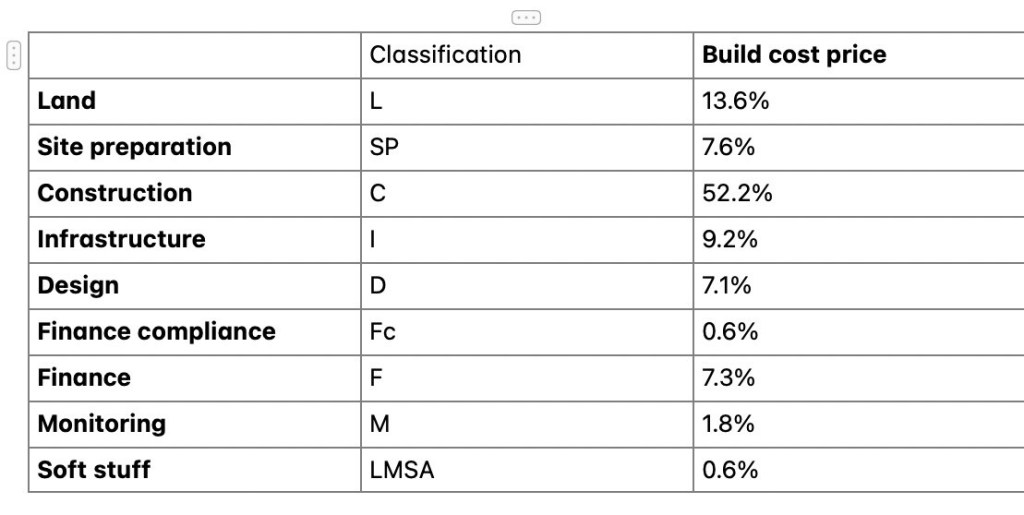
Percentage cost allocations for a medium density South Auckland Development 2021/2022.
So for this post I am tabling the percentage cost allocations I ended up following my now completed fourteen unit development in South Auckland. This development suffered under the lockdowns and huge challenges experienced from 2020 through to mid 2022. But it did finish and is fully occupied with a blend of tenants and owners in a very pleasant mini-community.
To put a framework around the costings as one cannot compare between projects easily: this was a medium density development consisting of three blocks (one block of terraces) and two separate apartment blocks. The land was horrid peat and it was designed to meet LifeMark and Homestar 6.0/7.0 requirements (my foundation is Responsibility). Eight apartments were sold and six terraces were retained. The macro-environment changed so much through-out the build time meaning that my choices on holding and selling had to flex accordingly. I landed where I landed, at the end, ready to move immediately into my next development (settle one loan and take out the next).
Would I do this model again? No, not without key changes as the cost of compliance was too high for the land available to share the overheads and the on-going compliance costs still bite. A bit unfortunate really as it is a nice use of the land space (suburban).
